
Effective May 1, 2026, the Ontario Energy Board rewrote a piece of the province’s Distribution System Code that most homeowners will never read, and that changes, in a meaningful way, what a well-engineered solar and battery system can now do on their roof.
Definitions are rarely exciting. This one is worth your attention.
A larger definition of microgeneration
For years, Ontario capped “microgeneration” systems, the category nearly every home solar installation falls under, at 10 kilowatts. That ceiling has moved to 12 kilowatts. Two kilowatts sounds like a rounding error until you translate it into roof space, into the share of your annual consumption you can offset, and into the number of homes previously turned away from the system size they actually needed. It is a genuine, if modest, widening of the aperture.
The real story: build bigger, export smart
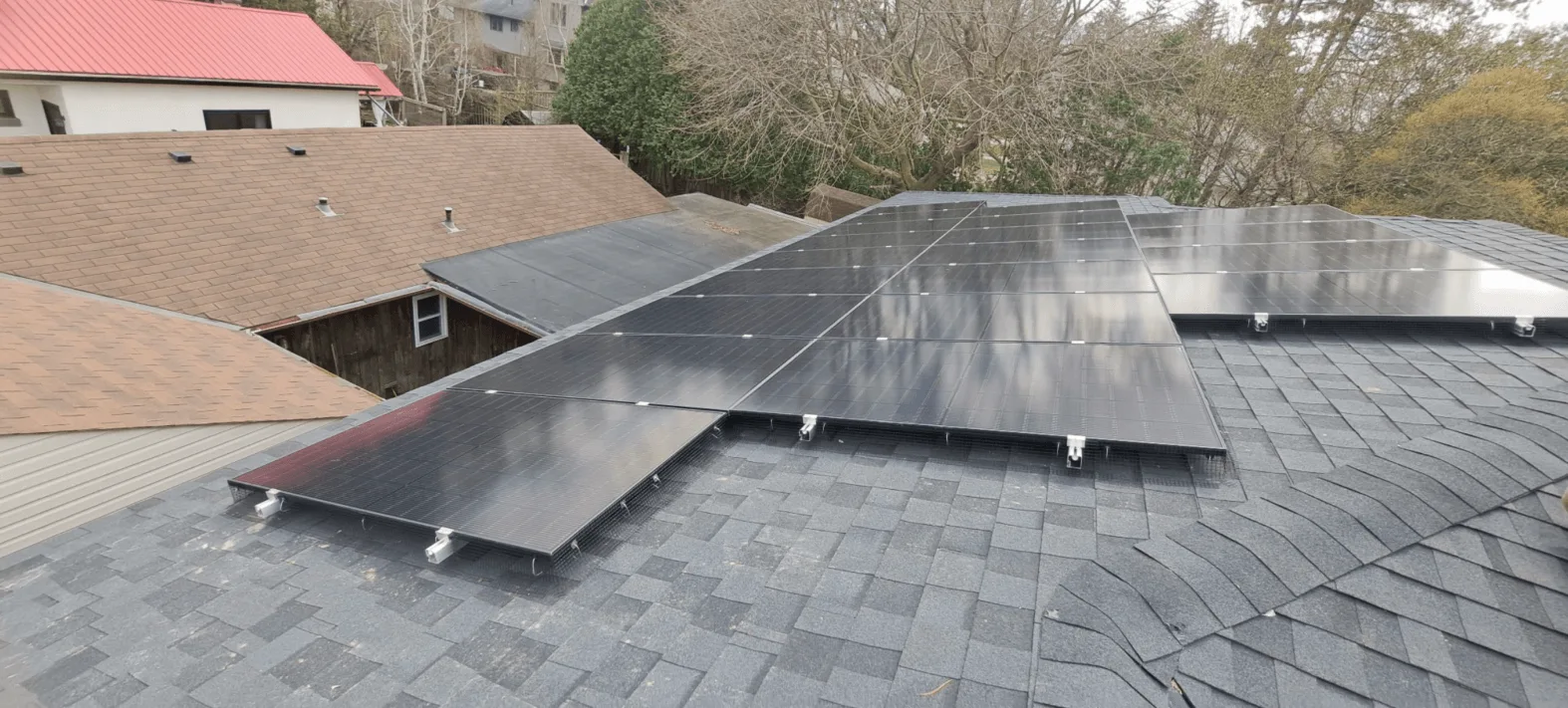
The more consequential change sits one layer down. Ontario utilities may now permit homeowners to install up to 24 kilowatts of generation capacity, twice the new microgeneration ceiling, provided exports to the grid are held to 12 kilowatts. The mechanism that makes this possible is a Power Control System: intelligent hardware that governs, in real time, how much of what your array produces actually leaves your property.
In practice, your roof can now carry a larger, more capable array than the rules previously allowed: sized for the shoulder seasons and the short days of an Ontario winter, engineered for genuine energy independence, while the utility’s export limit is respected automatically and invisibly.
A larger array, married to a smarter control layer, does something a bigger array alone never could: it turns a home into a serious energy asset rather than a seasonal one.
Why this matters more than the kilowatt figures suggest
Ontario’s solar resource is not evenly distributed across the calendar. A system sized to the old 10-kilowatt ceiling was, by definition, a system compromised for eight months of the year to satisfy the arithmetic of the other four. Building to the new 24-kilowatt allowance changes that calculus.
- Winter and shoulder-season performance improve meaningfully, because the array was never the bottleneck to begin with.
- Battery storage becomes a far more powerful partner, since there is now a genuine surplus of daytime generation to bank rather than curtail.
- The system is sized for where household demand is heading, not where it has been, as electric vehicles and heat pumps quietly raise the electrical draw of a modern home.
- Roof space stops going to waste. Capacity that regulation once left idle can now be put to work.
What a Power Control System actually does
Think of it as the difference between a car with an engine, and a car with an engine and a transmission. The engine, your solar array, is only half the system. A Power Control System is the transmission: it manages export in real time, keeps the installation inside the utility’s requirements without a homeowner ever having to think about it, and lets us engineer for the size of system your home deserves, rather than the smallest one the old rules would tolerate.
The Bluewater Difference
We design every system to the regulatory framework as it stands today, and the one that is coming. Homes we are building now are sized for the full 24-kilowatt allowance from day one, not retrofitted to it later.
What this means if you have been waiting
If solar was on your list and the numbers did not quite work under the old ceiling, or if a previous quote left you with a system that felt like a compromise, this is the moment to look again. The rules that constrained the conversation two years ago no longer apply.
At Bluewater Energy, this regulatory shift lets us do what we already do best, simply at a larger scale: engineer whole-home systems, generation and storage together, sized for genuine resilience and built to outperform for decades, not seasons.
This is not a policy footnote. It is an invitation to rebuild the case for solar around what your home can actually become: a serious, self-sufficient energy asset, engineered once, correctly, for the long run.