
Ontario’s net-metering framework transforms solar panel installations from environmental pursuit to strategic investment. Critically, execution determines outcome – and this is where Bluewater Energy shines as brightly as the sun.
The Net-Metering Framework
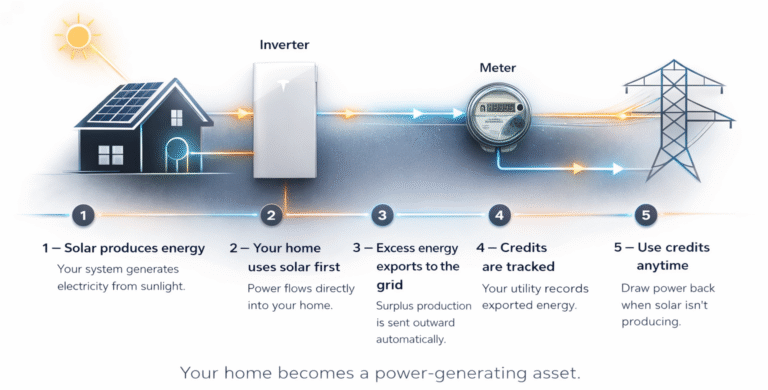
Net-metering in Ontario operates under provincial regulation, creating a standardized mechanism across all Local Distribution Companies (LDCs). The principle is elegant: your solar installation generates energy for your home and credits when producing more than you consume. Solar energy becomes the primary power source for your home when the sun is shining, and the credits offset grid consumption when production falls short.
The utility meter operates bidirectionally, recording generation back-fed to the grid during surplus generation, and consumption during solar deficit. Your monthly bill reflects net consumption: total usage minus solar production. During high-production months, you accumulate credits that carry forward for twelve months, effectively banking summer abundance for winter scarcity.

How Net Metering Works
Provincial oversight means consistent rules province-wide. While LDC application processes vary cosmetically, the fundamental framework remains identical from Toronto to Thunder Bay.
This standardization eliminates regional complexity for homeowners—but only when your provider possesses comprehensive regulatory fluency across all Ontario utilities.
Eliminate the Uncertainty
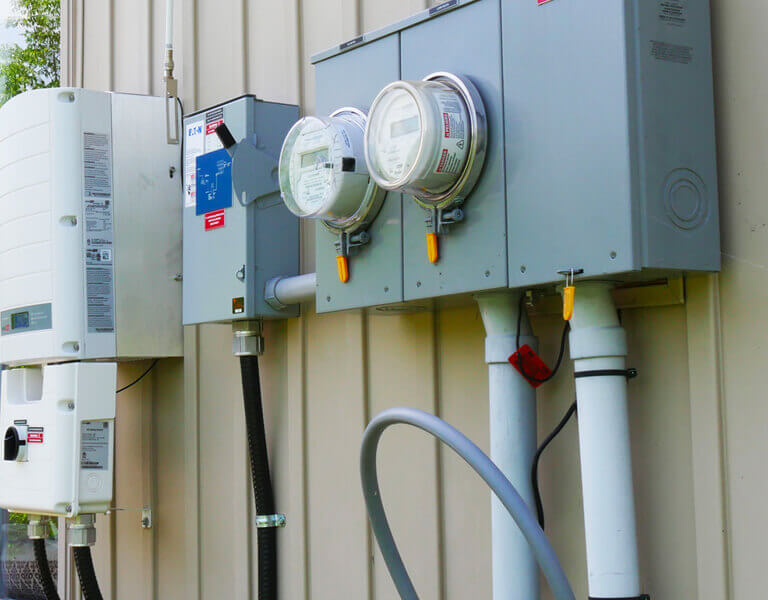
From utility consultation through final meter activation, we orchestrate the entire interconnection process. Your only involvement is to authorize us to act as a consultant on your behalf with the utility company, and to sign the approval documents. We take care of everything else.
Strategic Rate Architecture
Net-metering operates within Ontario’s residential rate structures. Your choice here, which is often overlooked by commodity-based installers, fundamentally shapes financial outcomes. This is where analytical rigor separates investment from expenditure. Bluewater Energy provides strategies for you that result from analysis of your actual energy consumption data, which is then compared against available rate structures. We don’t just install equipment, we design outcomes.
Solar Only Systems
Time-of-Use (TOU) Strategy
When your system lacks energy storage, TOU rates create optimal alignment. Your solar produces during mid-peak and on-peak periods (when generation is most valuable), while your primary consumption occurs during off-peak evening hours (when energy is cheapest).
This natural arbitrage – producing expensive electrons, consuming cheap ones – maximizes credit accumulation without battery investment. Simple, elegant, effective for consumption-pattern alignment.
Solar + Battery Storage Systems
Ultra-Low Overnight (ULO) Strategy
Battery integration unlocks ULO optimization. Your system exports 100% of daytime generation at standard rates while your storage supplies the home during the 4pm-9pm ultra-peak window, when grid rates spike dramatically.
The financial impact compounds: maximizing export credits plus elimination of your highest-cost consumption period. This isn’t incremental improvement, it is structural transformation of your energy economics.
The Conversation Your Installer Should Be Having
Rate structure selection requires intimate understanding of your consumption profile, seasonal variation, and system performance modeling. It’s analytical work, often more valuable than incremental panel additions.
When your installer doesn’t discuss rate strategy, they’re signaling commodity-based thinking. When we present rate analysis before equipment specification, we’re demonstrating investment architecture.
Ready to Explore What’s Possible?
Every property presents unique opportunities. Let’s analyze your specific consumption patterns, roof architecture, and financial objectives.
The Implementation Process
Between contract signature and system activation lies a regulatory gauntlet that separates functional installations from abandoned projects. This is where commodity providers vanish—and where Bluewater demonstrates value.
See the Difference Yourself
We invite comparative evaluation. Review our completed installations, speak with our clients, examine our documentation standards. Quality reveals itself upon inspection.
Component-Level Differentiation
The industry’s little known secret: “solar panel” is not a singular category. Component quality varies dramatically—and these variations compound over decades of operation. Explore the differences between a partner focused on providing premium quality equipment, workmanship, and long-term value for you vs. commodity-based installation companies offering the cheapest product at the lowest price.
SolarEdge
Power Optimization Architecture
Panel-level optimization eliminates the performance degradation from shading, soiling, or individual module issues. Where string inverters create lowest-common-denominator performance, SolarEdge maintains peak efficiency across the array.
The SolarEdge battery-ready HUB inverter technology delivers 99% efficiency while eliminating the electromagnetic interference that plagues cheaper alternatives. These are measurable performance differences visible in your production data and the environment within your home.
Tesla Powerwall
Integrated Energy Storage
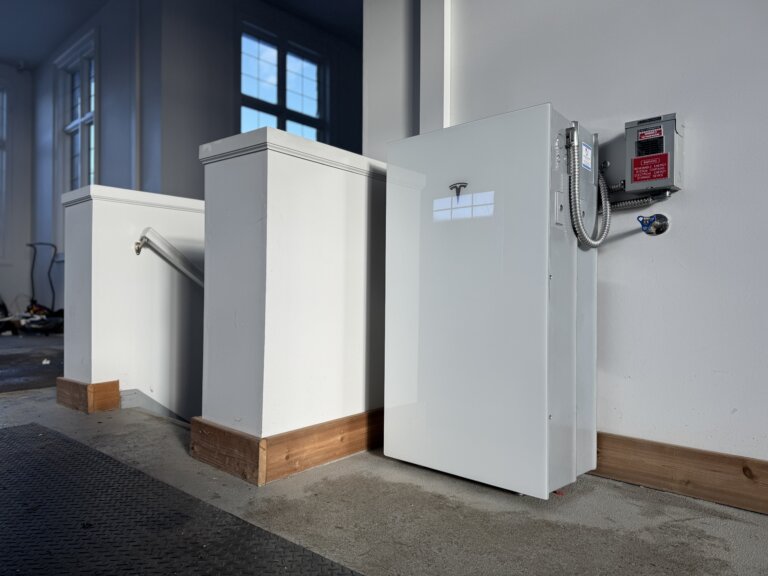
When storage enters the equation, component integration becomes critical. Tesla’s Powerwall doesn’t merely store energy, it intelligently orchestrates energy consumption in your home, with grid and solar interaction, and backup functionality through sophisticated software.
The hardware specifications matter: 13.5kWh capacity, 10kW+ continuous output, and integrated inverter for DC coupled design. The differentiation lives in the control architecture with time-based optimization, storm watch activation, seamless grid transition during outages. Flexibility and programmability at your finger tips.
Load Management Capability
The Specification That Matters
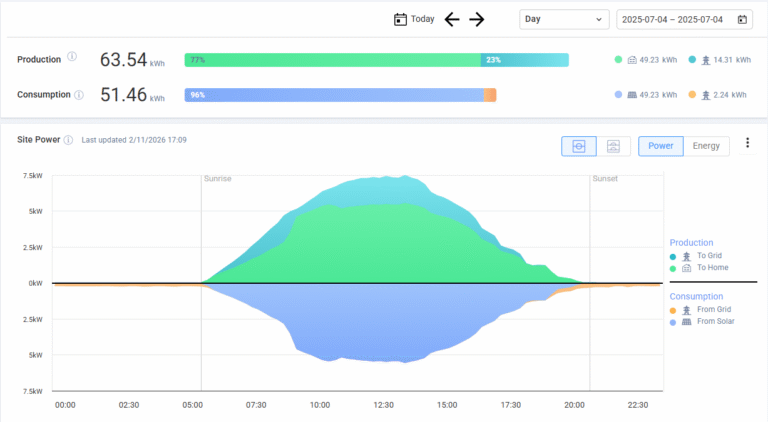
The ability to monitor and control your energy consumption right down to the individual circuit, appliance, and lighting level transforms your net-metered microgrid into a smart home energy asset that protects the most vital systems in the most critical moments.
We provide technology that stays in constant communication with your solar and battery system, monitoring your total energy consumption in combination with solar production and battery storage levels, to optimize your financial benefit and backup security protection. End-to-end encryption secures your privacy.
Protect Your Home
We view your home as one of, if not the, most valuable and important assets in your life, and we treat it with the care and attention something this important deserves. Commodity-based installation companies offering the cheapest equipment at the lowest price introduce numerous risks to your home. Our systems, processes, equipment, and workmanship guarantee that your home is protected.
The Craftsmanship Imperative
Installation quality isn’t aesthetic preference, it’s structural integrity, electrical safety, long-term performance, and ultimately, the return on your investment. Your roof is not a training ground.
Visible Differentiation
Our installations photograph like architectural features because we treat them as such. Panel alignment precise to millimeters. Conduit routing that follows rooflines with geometric intention. Mounting hardware that disappears into the structure rather than cluttering the aesthetic.
This isn’t vanity—it signals thoroughness. When installers care about visual impact, they care about everything. When they don’t, you’re seeing their actual standards.
Structural Considerations
Every roof penetration is a potential failure point. We employ flashing systems engineered for Canadian weather extremes—not the commodity sealant-and-prayer approach. Our mounting attachments integrate with roof structure, distributing load properly rather than concentrating stress.
The difference compounds over decades. Proper installation means your roof’s warranty remains intact, your structure experiences no accelerated aging, and your insurance carrier has no performance concerns.
Electrical Precision
Master electricians vs. general labour. We’re not suggesting competitors employ incompetent technicians—merely that electrical expertise exists on a spectrum, and ours operates at the professional terminus.
This manifests in wire sizing that exceeds code minimums, connection terminations that maintain full conductivity across temperature cycles, grounding systems that actually protect equipment, and labeling that enables future service rather than creating diagnostic mysteries.
An Energy Plan For Your Home or Business
Bluewater Energy focuses on your goals and respects that your individual home or business, and the way you operate it, is unique and deeply personal. This means that you need a custom tailored solution to meet your long-term energy needs. Our approach prioritizes developing a premium solution that is going to meet your daily demands today, and provide scalability well into the future as your needs grow.
Partnership Architecture
We’re not selling you a solar installation. We’re establishing a decades-long relationship with your home’s energy infrastructure. The distinction determines every subsequent interaction.
Comprehensive Project Orchestration
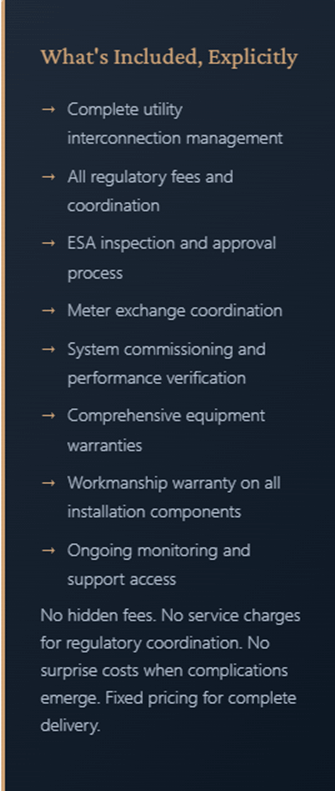
From initial analysis through final activation, we own every component: utility coordination, regulatory navigation, installation execution, inspection management, activation confirmation. Your involvement: approval of design and access to your property. Everything else is our domain.
Performance Verification
Post-activation, we don’t disappear. System commissioning includes performance verification against our modeling—confirming production meets projections. Monitoring system integration ensures you can observe real-time and historical performance. We review first-year production data to validate system behavior.
Ongoing Stewardship
Your system will operate for 25-30 years. During that span, questions emerge, optimization opportunities appear, technology evolves. We remain available—not as transactional service provider, but as the institutional knowledge holder for your specific installation.
When you call five years from now with questions about production anomalies, we have your complete installation documentation, equipment specifications, and historical performance data. We’re not troubleshooting a stranger’s system—we’re supporting our own work.
The Economic Reality
Premium installation costs more initially. This is arithmetic fact. The return calculation, however, extends across decades. Higher efficiency equipment, superior degradation characteristics, and flawless installation translate to measurably higher lifetime production.
Meanwhile, commodity installations face service calls, premature component replacement, and accelerated performance decline. The true cost comparison isn’t initial capital—it’s lifecycle value. We optimize for the latter.
S
Start the Conversation
Net-metering provides the framework. Equipment selection, installation precision, and strategic design determine the outcome. Let’s discuss what’s possible for your specific property.